



Recovery doesn’t always end the day a patient leaves the hospital. In fact, for a lot of families, that’s when the real decisions begin. Do you bring mum or dad home and manage to recover yourselves? Do you keep them admitted a little longer? Or do you look into professional care that comes to your doorstep?
This is one of the most common dilemmas families face after a surgery, a fall, a stroke, or any major illness in an elderly parent. And honestly, there’s no one-size-fits-all answer. The right choice depends on the condition, the home setup, and how much support is realistically available. Let’s break down home care vs hospital care so you can make a decision that actually fits your situation, not just a generic checklist.
What Hospital Care Is Designed For
Hospitals exist for a reason — they’re built around emergencies, complex procedures, and conditions that need constant monitoring. If a patient has just come out of major surgery, needs ventilator support, IV medication adjustments, or round-the-clock specialist attention, a hospital is simply the safer place to be.
The strength of hospital care is access — to doctors, to equipment, to immediate intervention if something goes wrong. But that same environment can also work against elderly patients once the acute danger has passed. Hospitals are noisy, unfamiliar, and often disorienting for older adults, especially those already dealing with memory issues or anxiety.
What Home Healthcare Provides
This is where home healthcare services step in — not as a replacement for hospitals, but as the next stage of recovery once the critical phase is over.
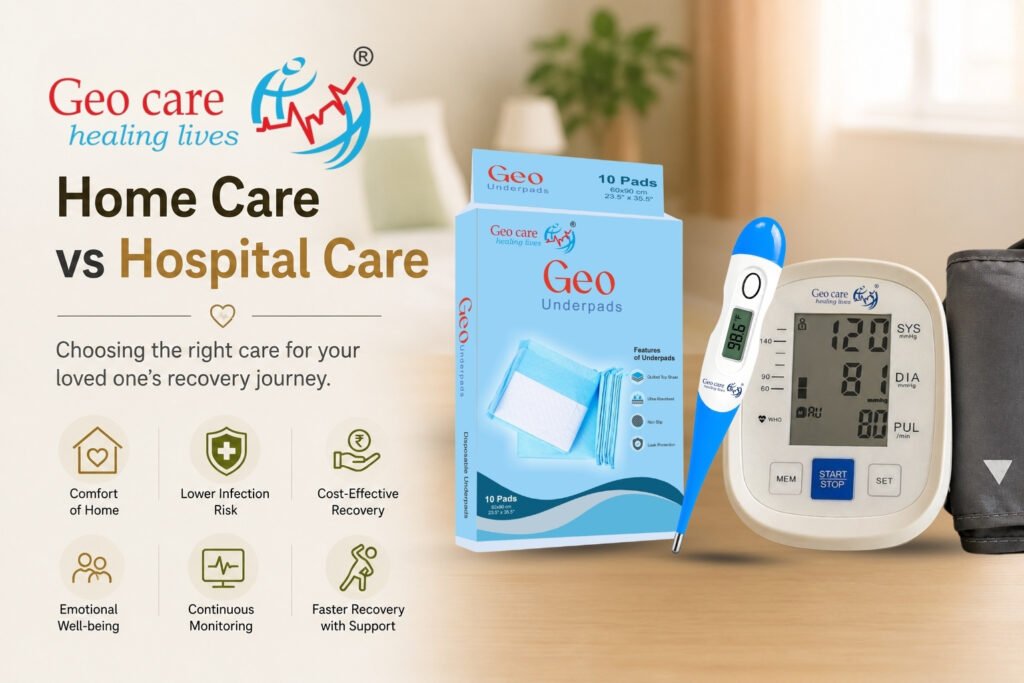
Good home care today looks a lot more capable than most people expect. With the right setup — a nebulizer for breathing support, a BP monitor for daily tracking, a thermometer for infection checks, plus basics like underpads and adult diapers for hygiene and comfort — a lot of recovery can genuinely happen at home, safely and comfortably.
Post-hospital care at home often includes physiotherapy visits, medication management, wound care, mobility support, and regular vitals monitoring — essentially recreating the supportive parts of a hospital stay, minus the disruption of being away from family and familiar surroundings.
Comparing the Two: What Actually Matters
Comfort — Home wins here almost every time. Familiar rooms, home-cooked food, and family presence genuinely help elderly patients feel calmer and less anxious during recovery.
Cost — Extended hospital stays add up quickly between room charges, nursing fees, and incidental costs. Elderly recovery at home is usually more cost-effective once the acute treatment phase is complete.
Infection risk — Hospitals, despite best efforts, carry a higher risk of hospital-acquired infections, which is a real concern for elderly patients with weaker immunity. Home environments significantly reduce this exposure.
Emotional well-being — Isolation and disorientation are common complaints among elderly hospital patients. Being home, surrounded by family, routine, and familiar faces, tends to support better mental health during recovery.
Recovery outcomes — Interestingly, for stable, non-critical recovery, studies and clinical experience both suggest patients often recover just as well — sometimes better — at home, provided proper equipment and monitoring are in place.
When Hospital Care Is Still Essential
There are situations where home care simply isn’t appropriate yet:
- Immediately after major surgery requiring specialist monitoring
- Unstable vitals or ongoing risk of complications
- Need for ventilator or ICU-level support
- Conditions requiring frequent diagnostic testing
In these cases, rushing a patient home too early can do more harm than good.
When Home Care Is the Better Option
Once the patient is medically stable, home care often becomes the smarter choice:
- Recovery from planned or low-risk surgeries
- Chronic condition management (diabetes, hypertension, mobility issues)
- Rehabilitation at home after strokes or fractures, with physiotherapy support
- Long-term elderly care where quality of life matters as much as clinical metrics
Tips for Choosing the Right Care
- Talk to the treating doctor honestly about whether the patient is stable enough for discharge.
- Assess your home setup — space, hygiene, and someone available to assist daily.
- Invest in basic senior recovery equipment early, rather than scrambling later.
- Consider a hybrid approach: hospital for the critical phase, home care for the recovery phase.
- Don’t underestimate emotional readiness — both for the patient and the family.
Conclusion
There’s no universal right answer between home care and hospital care — the best choice is almost always a combination of both, used at the right stage of recovery. What matters most is having the right support and equipment ready when the time comes to bring a loved one home.
At Geocare Healthcare, we work closely with families and caregivers across India to make that transition easier — supplying the everyday essentials that make home healthcare services genuinely reliable, from monitoring devices to hygiene disposables. If you’re planning a loved one’s recovery at home, Geocare Healthcare is a good place to start figuring out what you’ll actually need.