



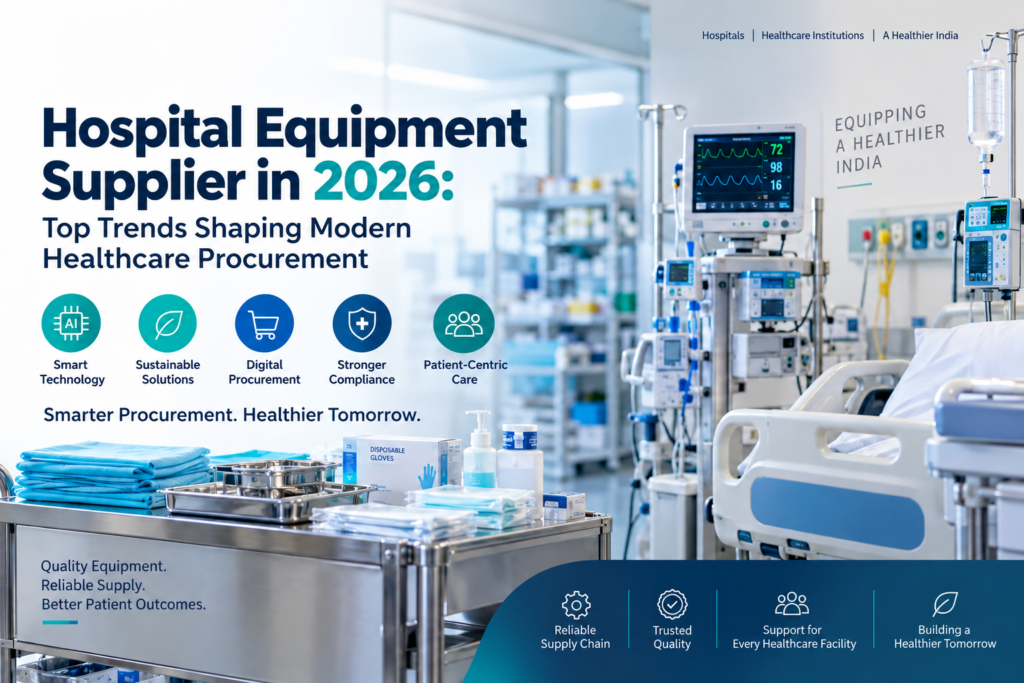
Hospital procurement has changed dramatically. A few years ago, a purchase team could compare specifications, negotiate a price, place an order, and move on. In 2026, that approach leaves too many risks unanswered.
Hospitals now need to know whether equipment is compliant, whether consumables will remain available, how quickly replacements can be supplied, what after-sales support exists, and what the product will actually cost over its working life.
This shift has changed what healthcare organisations expect from a hospital equipment supplier. Hospitals are no longer simply buying products. They are building supply relationships that affect clinical continuity, operating costs, infection control and emergency preparedness.
For Indian healthcare organisations, the change is particularly relevant. India’s medical-device ecosystem is expanding rapidly, while domestic manufacturing, regulatory oversight and healthcare infrastructure continue to develop. IBEF reports that India’s medical devices market was valued at around US$15.2 billion in 2025 and has been projected to reach US$50.1 billion by 2030.
So what should procurement teams expect from a hospital equipment supplier in 2026?
What Is a Hospital Equipment Supplier in 2026?
Traditionally, a hospital equipment supplier sourced and delivered products requested by hospitals or clinics. The modern role is much broader.
A capable supplier may support healthcare facilities with:
- Medical devices and monitoring equipment
- Examination and surgical products
- Infection-control products
- Personal protective equipment
- Hospital consumables
- Patient-care products
- Hospital linen
- Emergency Medical Supplies
- Product specifications and documentation
- Bulk and institutional procurement
- Inventory planning and repeat ordering
- Regulatory and compliance documentation
- After-sales assistance
The strongest supplier relationships now sit somewhere between distribution, procurement support and supply-chain management.
A hospital may purchase a blood pressure monitor only once, for example, but gloves, masks, gowns, hygiene products and other Hospital equipment and supplies must be replenished continuously. Procurement therefore has to consider both equipment and the ongoing products required to keep departments functioning.
Why Choosing the Right Hospital Equipment Supplier Matters
A late delivery of ordinary office supplies is inconvenient. A shortage of examination gloves, masks or essential patient-care products can affect clinical operations immediately.
That difference explains why supplier reliability deserves as much attention as price.
Consider a hospital preparing for a seasonal increase in respiratory cases. Procurement may have secured attractive prices on masks, nebulisation products and protective supplies, but those savings become irrelevant if the vendor cannot maintain stock when demand rises.
A dependable Medical Equipment Supplier helps reduce this operational uncertainty.
The right sourcing relationship can provide several advantages:
- More predictable product availability
- Consistent specifications and quality
- Faster replenishment of essential products
- Better procurement documentation
- Simplified ordering across multiple categories
- Improved visibility of expenditure
- Easier handling of bulk requirements
- Better support during unexpected demand
For procurement managers, consistency is often more valuable than saving a small percentage on a single purchase.
Top Hospital Equipment Supplier Trends Shaping 2026
1. Compliance Is Becoming a Procurement Requirement, Not an Afterthought
Procurement teams are placing greater attention on product documentation and applicable regulatory requirements.
India regulates medical devices under the Medical Devices Rules, 2017, and CDSCO states that medical devices in India fall within the country’s regulatory framework.
A November 2025 CDSCO circular also reminded procurement agencies, including hospitals, that appropriate Indian licensing requirements apply to regulated medical devices; overseas certifications such as CE or US FDA credentials do not replace applicable Indian regulatory requirements.
For buyers, this means the cheapest quotation should never automatically become the winning quotation.
Before approving a hospital equipment supplier, procurement teams should verify documentation relevant to that particular product category, rather than assuming every healthcare product follows exactly the same certification requirements.
2. Total Cost of Ownership Is Replacing Lowest-Price Buying
Imagine two devices.
Device A costs ₹10,000 less initially but requires expensive consumables, frequent servicing and long waits for replacement components.
Device B costs slightly more but has dependable servicing, readily available accessories and a longer practical operating life.
Which one is cheaper?
Increasingly, hospitals are calculating the answer across the entire lifecycle.
Total cost of ownership can include:
- Initial acquisition price
- Installation
- Training
- Consumables
- Preventive maintenance
- Repairs
- Spare parts
- Downtime
- Replacement cycle
- Disposal costs
WHO’s September 2026 guidance on medical-device lifecycle management specifically encourages procurement systems to connect purchasing decisions with long-term functionality, maintenance, forecasting, and service requirements.
A modern Medical Equipment Supplier should therefore be evaluated on what happens after the invoice is issued, not only before it.
3. Domestic Manufacturing Is Changing Supplier Portfolios
India’s push toward domestic medical-device manufacturing is giving institutional buyers more sourcing possibilities.
The Economic Survey 2025–26 reported that, under the medical-device Production Linked Incentive scheme, manufacturing had started for 57 high-end medical devices as of September 2025. It also highlighted continued investment in medical-device parks and programmes aimed at strengthening the domestic industry.
This does not mean hospitals should automatically choose domestic or imported equipment.
It means procurement teams have a wider pool to evaluate.
The practical question for a hospital equipment supplier is becoming: can you offer products that combine dependable quality, regulatory compliance, suitable pricing, and sustainable availability?
4. Digital B2B Procurement Is Becoming Standard Practice
Hospital purchasing still involves quotations, approvals, and negotiations, but more of that workflow is moving online.
Instead of repeated emails and spreadsheets, institutional buyers increasingly expect access to:
- Digital product catalogues
- Product specifications
- Online RFQs
- Account-based pricing
- Order history
- Invoice history
- Reordering facilities
- Stock information
- Shipment tracking
- Downloadable compliance documents
Digital procurement is not simply about convenience. It creates a more traceable purchasing process.
GeoCare, for example, supports institutional and distributor purchasing through B2B account features including quotation requests, order history, invoice history and reordering capabilities.
For hospitals buying hundreds of different Hospital equipment and supplies, fewer manual procurement steps can mean fewer errors and faster replenishment.
5. Supply-Chain Resilience Is Becoming a Buying Criterion
Healthcare procurement teams learned a difficult lesson during recent global supply disruptions: having an approved product is not enough if that product cannot reach the hospital when required.
In 2026, hospitals are increasingly thinking about resilience.
Questions worth asking a supplier include:
- Where is inventory stored?
- What is the typical dispatch time?
- Are alternative products available during shortages?
- Can the supplier support scheduled replenishment?
- Can it handle sudden increases in quantity?
- Are critical items dependent on a single source?
This matters particularly for Emergency Medical Supplies, PPE, infection-control products and high-usage consumables.
A reliable hospital equipment supplier should be able to discuss availability realistically rather than promising unlimited stock.
6. Procurement Is Moving Toward Strategic Stock Planning
Overstocking ties up capital and creates expiry or storage risks. Understocking can interrupt patient care.
The answer lies between the two.
Hospitals are increasingly using consumption history, lead times and departmental demand to establish minimum and reorder levels.
For example, instead of ordering examination gloves only when stores report critically low inventory, procurement teams can establish usage patterns by size, department and monthly consumption.
The same approach can be applied to masks, gowns, hygiene products and Emergency Medical Supplies.
WHO’s recent medical-device lifecycle guidance also emphasises forecasting and strategic stockpiles as part of more resilient healthcare procurement.
The best Medical Equipment Supplier relationships can support that planning with consistent product availability and predictable ordering cycles.
7. Sustainability Is Entering Healthcare Procurement
Environmental impact is gradually becoming another purchasing consideration.
WHO estimates that a substantial share of healthcare-related emissions comes from supply chains and has encouraged health systems to incorporate sustainability into procurement decisions.
India is also progressing toward mercury-free medical measuring devices, including alternatives to traditional mercury thermometers and sphygmomanometers.
For procurement teams, sustainable purchasing can involve evaluating:
- Product durability
- Packaging volume
- Waste generation
- Reusable versus disposable options where clinically appropriate
- Energy requirements
- Responsible disposal
- Mercury-free alternatives
Price and clinical suitability remain critical, but environmental performance is becoming part of the broader value equation.
Important Factors When Choosing a Hospital Equipment Supplier
Before adding a supplier to an approved vendor list, hospitals should evaluate more than the catalogue.
Product Quality and Documentation
Ask for specifications, applicable certificates and regulatory information before purchase.
Supply Reliability
A hospital equipment supplier should demonstrate consistent fulfilment capability for regularly consumed products.
Product Range
Working with a supplier that carries multiple categories of Hospital equipment and supplies can simplify vendor management and consolidate purchases.
After-Sales Support
For equipment and devices, confirm warranty terms, servicing arrangements and escalation procedures.
Institutional Procurement Capability
Bulk hospital orders require different processes from individual retail purchases. Check whether the supplier understands quotations, GST documentation, institutional billing and scheduled supply.
Product Information
Detailed specifications and documentation help clinical and procurement teams compare products accurately.
GeoCare provides access to product catalogues, compliance information and user documentation through its online resources, supporting more informed procurement decisions.
Common Procurement Mistakes to Avoid
One of the biggest mistakes is selecting a hospital equipment supplier purely because it submitted the lowest quotation.
Other common errors include:
- Failing to verify applicable regulatory documentation
- Ignoring replacement consumable costs
- Buying products without considering future availability
- Maintaining only one source for critical supplies
- Overlooking storage and expiry requirements
- Not checking warranty and servicing terms
- Ordering Emergency Medical Supplies only after demand increases
- Comparing products with different specifications as though they were identical
Good procurement is not simply about spending less. It is about obtaining appropriate products without creating avoidable clinical or operational risk.
Expert Tips for Better Healthcare Procurement in 2026
Procurement teams can make supplier management stronger with a few practical changes.
Create separate purchasing strategies for capital equipment, routine consumables and critical emergency products.
Maintain a supplier scorecard covering delivery reliability, quality issues, documentation, response times and pricing consistency.
For frequently used Hospital equipment and supplies, establish minimum stock levels based on actual consumption rather than estimates.
Review supplier performance quarterly instead of waiting for a problem.
Most importantly, involve clinical, biomedical, infection-control, and procurement teams when evaluating products that directly affect patient care.
The procurement department negotiates the purchase, but the people using the product every day often identify problems that spreadsheets cannot.
What Will Define a Leading Hospital Equipment Supplier Beyond 2026?
The next stage of healthcare procurement will be increasingly data-driven.
Indian hospitals are investing more heavily in digital systems, automation and data-led healthcare operations. A 2025 EY-CII survey reported that hospital IT innovation spending was expected to rise by 20–25% over the following two to three years.
That same digital mindset is likely to influence procurement.
Expect supplier evaluation to place greater emphasis on:
- Real-time inventory visibility
- Automated replenishment
- Digital documentation
- Procurement analytics
- Product traceability
- Lifecycle costing
- Predictive demand planning
- Integrated B2B ordering
The future Medical Equipment Supplier will increasingly compete on information, reliability and service—not simply product availability.
Frequently Asked Questions
1. What should hospitals look for in a hospital equipment supplier?
Hospitals should evaluate product quality, applicable regulatory documentation, supply reliability, pricing transparency, product availability, after-sales support and experience with institutional procurement.
2. Why is supplier reliability important in hospital procurement?
Hospitals consume many products continuously. Delays in essential Hospital equipment and supplies can disrupt routine operations, infection-control procedures or patient care.
3. How should hospitals evaluate a Medical Equipment Supplier?
Evaluate the supplier’s documentation, product specifications, delivery record, warranty or service arrangements, stock availability, complaint handling and total cost of ownership.
4. What are Emergency Medical Supplies?
Emergency Medical Supplies can include products needed for urgent clinical response, patient stabilisation, infection control, respiratory support, and emergency preparedness. Exact requirements depend on the facility and services provided.
5. Is price the most important factor when buying hospital equipment?
No. Purchase price should be assessed together with quality, compliance, consumables, maintenance, serviceability, supply continuity and expected product life.
6. Why is lifecycle costing becoming important in hospital procurement?
Lifecycle costing helps hospitals identify the real cost of a product by considering maintenance, consumables, repairs, downtime and replacement—not simply its initial purchase price.
7. How can hospitals reduce shortages of essential supplies?
Hospitals can analyse historical consumption, establish minimum inventory levels, improve demand forecasting, maintain reliable vendor relationships and develop contingency sources for critical products.
Choosing the Right Hospital Equipment Supplier for the Next Era of Healthcare
Healthcare procurement in 2026 is becoming more disciplined, connected, and strategic.
The strongest procurement teams are no longer asking only, “What does this product cost?”
They are asking: Is it compliant? Will it remain available? Can our staff use it effectively? What will it cost throughout its lifecycle? Can the supplier support us when demand suddenly changes?
Those questions are redefining what healthcare organisations expect from a hospital equipment supplier.
GeoCare Healthcare Products Pvt. Ltd. supports hospitals, clinics, laboratories, institutions and healthcare procurement teams with medical devices, infection-control products, hospital consumables, examination gloves, hospital linen, adult-care products and other healthcare essentials. Its B2B-focused approach includes institutional procurement support, product documentation, quotation requests and dependable supply solutions across India.
For healthcare organisations reviewing their procurement strategy for 2026 and beyond, explore GeoCare Healthcare to discover products, request information, or discuss bulk and institutional supply requirements.