



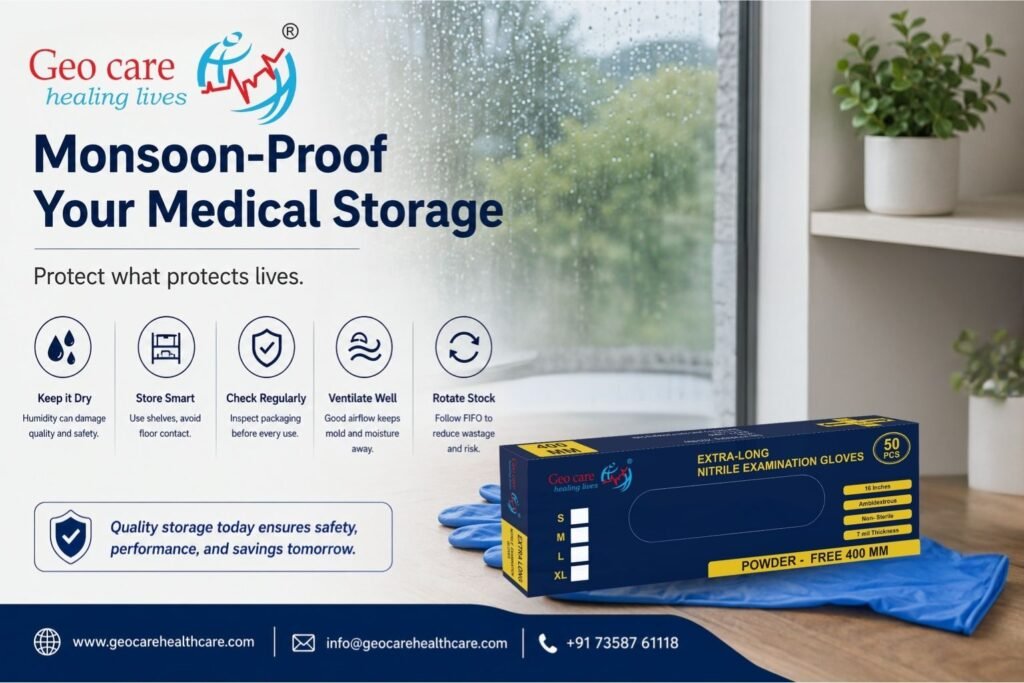
If you run a clinic, a small pharmacy, or you’re simply caring for a family member at home, you already know the monsoon changes everything — the roads, the mood, and yes, even your medical supplies. Most people never think about monsoon-proofing medical storage until they open a box of gloves that feels sticky, or a pack of masks that smells faintly musty. By then, the damage is already done.
Humidity isn’t just an inconvenience in India — it’s a genuine threat to the safety and shelf life of the disposables we rely on every day. Let’s talk about what’s actually happening inside those boxes, and how you can protect what you’ve already paid for.
Why Humidity Is the Silent Enemy of Medical Supplies
Every medical disposable — whether it’s a nitrile glove, a surgical mask, or an adult diaper — is designed to perform in a specific range of temperature and moisture. Monsoon humidity pushes past that range, often quietly, without any obvious warning sign until it’s too late.
Moisture in the air doesn’t just sit outside your storage room. It seeps into cardboard boxes, settles on plastic packaging, and slowly changes the internal environment your supplies are sitting in — even if the room “feels” fine to you.
What Happens to Gloves in High Humidity
Medical gloves storage is one of the most overlooked areas of monsoon prep. Nitrile and latex gloves are both sensitive to excess moisture:
- Powdered latex gloves can absorb moisture and clump together, making them harder to put on cleanly.
- Nitrile gloves, while more durable than latex, can still develop a tacky or slightly sticky surface if stored in a damp, poorly ventilated space for weeks.
- Cardboard boxes holding gloves can soften and collapse, exposing the inner packaging to dust, insects, and further moisture.
The result isn’t always visible immediately — but weakened glove material means a higher chance of tears during use, which defeats the entire purpose of wearing them.
Masks Lose Their Protection Faster Than You Think
Surgical and N95-style masks rely on multiple layers, including a filtration layer that’s specifically designed to stay dry. Once humidity gets in:
- The filtration layer can lose some of its effectiveness
- Elastic ear loops become brittle or lose their stretch over time
- Metal nose clips can start to rust if masks are stored near damp walls or windows
For clinics and hospitals working through large volumes of masks daily, even a small percentage of compromised stock adds up to real cost — and real risk.
Adult Diapers and Underpads Need Extra Care
This is one area people rarely discuss, but it matters enormously for home caregivers. Adult diapers and underpads are built with absorbent cores that are meant to activate only during use. If they’re exposed to ambient humidity for long periods:
- The absorbent material can pre-activate slightly, reducing effectiveness when it’s actually needed
- Packaging seals can weaken, letting in moisture and reducing hygiene
- Products stored in damp godowns or store rooms can develop odour even before opening
For families managing home care for elderly parents, this is exactly the kind of detail that gets missed — until the product simply doesn’t perform the way it should.
Simple Ways to Protect Your Medical Storage This Monsoon
You don’t need an industrial setup to protect your supplies. A few consistent habits go a long way:
- Store above ground level — always use shelves or pallets, never let boxes sit directly on the floor.
- Keep storage rooms ventilated — stagnant air traps humidity; a simple exhaust fan or periodic airing helps.
- Use silica gel packets in bulk storage areas, especially for gloves and masks.
- Avoid stacking boxes against outer walls, where dampness collects first.
- Rotate stock regularly — first in, first out, so nothing sits unused through an entire monsoon season.
- Check packaging integrity before use, not just before storage.
Why Sourcing Quality Matters Just as Much as Storage
Good storage habits only work if you’re starting with reliable products in the first place. This is where working with a trusted medical disposables supplier makes a real difference — consistent packaging quality, proper batch handling, and materials that are built to withstand real-world Indian conditions, not just lab conditions.
At Geocare Healthcare, this is something we think about long before a product reaches your shelf — from how it’s packed to how it travels across the country before reaching hospitals, clinics, and homes. Because monsoon-proofing isn’t just about what you do after the delivery arrives; it starts with what happens before it ever leaves the warehouse.
If you’re rethinking how your clinic, pharmacy, or home care setup handles this season, it might also be a good time to review who you’re sourcing from. Geocare Healthcare works with hospitals and caregivers across India to make sure the basics — gloves, masks, diapers, and everyday disposables — hold up, monsoon after monsoon.